



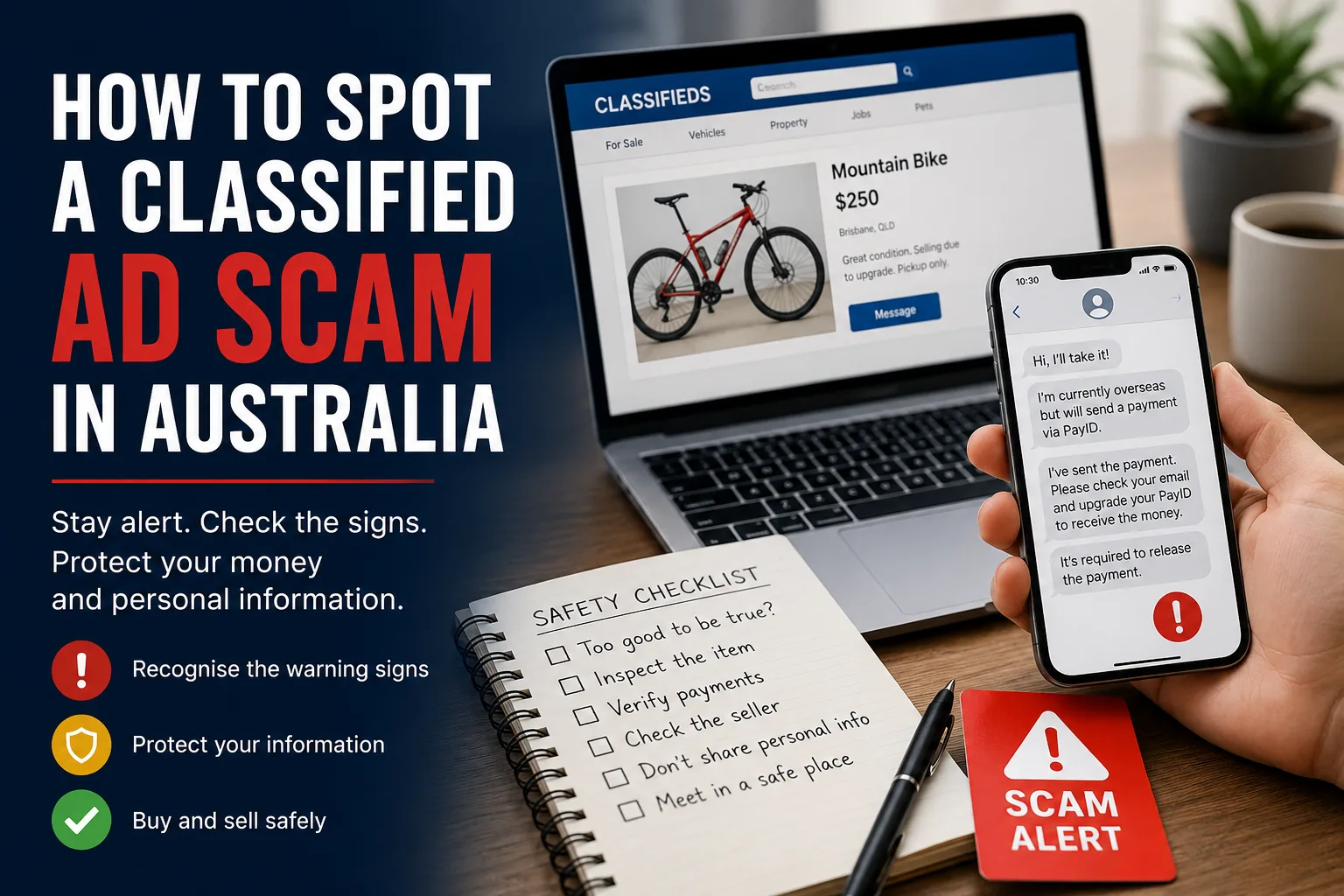
How to Spot a Classified Ad Scam in Australia
Buying and selling through online classified advertisements can be a convenient way to find a bargain, clear unwanted items from your home or reach local customers.
Unfortunately, scammers also use classified sites, social media and online marketplaces to target both buyers and sellers. They may advertise products that do not exist, send fake payment confirmations, impersonate trusted payment services or attempt to collect personal information for identity theft.
Scammers frequently create fake advertisements and profiles that appear genuine. Some advertise popular products at unusually low prices, while others pose as enthusiastic buyers and invent reasons why you must send money before receiving payment.
Learning the warning signs can help you recognise a suspicious advertisement or message before losing money or revealing sensitive information.
What Is a Classified Ad Scam?
A classified ad scam occurs when someone uses an advertisement or enquiry to deceive another person into sending money, providing goods or sharing personal information.
The scammer may pretend to be:
-
A private seller offering an item
-
A buyer interested in something you advertised
-
A business selling discounted products
-
A landlord advertising a property
-
A breeder selling a puppy or other pet
-
A courier or delivery company
-
A payment provider such as PayID
-
A representative of the classified advertising platform
The advertisement, buyer or product may appear convincing. Scammers can copy photographs and descriptions from genuine listings, use false identity details and create payment messages that look similar to legitimate bank notifications.
Common Warning Signs of a Classified Ad Scam
One suspicious detail does not always prove that someone is dishonest. However, several warning signs appearing together should make you stop the transaction and investigate further.
1. The Price Is Unbelievably Low
A highly desirable vehicle, phone, caravan, appliance or piece of machinery advertised far below its usual market value may be intended to attract buyers quickly.
The seller may claim that they:
-
Need an urgent sale
-
Are moving overseas
-
Have inherited the item
-
Are selling for a relative
-
Are serving in the military
-
Are unable to meet because of work
-
Have already relocated interstate
Some legitimate sellers do need a quick sale, but an unusually low price combined with excuses about inspections or payment is a serious warning sign. Scamwatch identifies unrealistically cheap products as a common feature of buying and selling scams.
Before proceeding, compare the price with several similar items. A vehicle that normally sells for $25,000 is unlikely to be genuine when advertised for $8,000 without a clear and verifiable reason.
2. The Seller Refuses an Inspection
Be extremely cautious when a seller will not allow you to inspect an expensive item before paying.
Typical excuses include:
-
The item is stored with a transport company
-
The seller is temporarily overseas
-
The vehicle is in another state
-
The item has already been packaged for delivery
-
A family member is handling the sale
-
The seller is unavailable because of work
-
Too many other buyers are interested
Scamwatch recommends inspecting expensive items such as cars, boats and caravans in person before making payment.
When an in-person inspection is impractical, request a live video call. Ask the seller to show the item from different angles and perform an unpredictable action, such as displaying a handwritten note containing your name and the current date.
A prerecorded video does not prove that the person contacting you owns the item.
3. You Are Pressured to Act Immediately
Scammers often manufacture urgency so that you do not have time to investigate.
You may be told:
-
Another buyer is about to pay
-
The discounted price is available today only
-
A deposit must be sent immediately
-
The courier is already waiting
-
Your account will be suspended
-
A payment will expire within minutes
-
You must refund an overpayment immediately
A genuine buyer or seller should allow reasonable time to verify the item, payment and identity of the other party.
When someone is rushing you, stop communicating temporarily. Review the messages carefully and discuss the transaction with someone you trust.
Common Scams Targeting Classified Ad Sellers
People advertising items for sale are often targeted within minutes of publishing an advertisement.
The Fake PayID Upgrade Scam
PayID is a genuine Australian payment service that allows people to send money using information such as a mobile number, email address or ABN linked to a bank account. When making a PayID payment, the payer is shown the name connected to the PayID before confirming the transfer.
However, scammers impersonate PayID and send fake emails or text messages claiming that:
-
Your payment is waiting
-
Your PayID account has a limit
-
You need to upgrade to a business account
-
The buyer has sent extra money
-
You must refund part of the payment
-
You must pay a fee before receiving the funds
These messages are scams. PayID states that it will never contact you directly, ask you to send money to receive money or require you to upgrade your account.
Receiving money through PayID does not require the seller to pay a fee to the buyer.
Do not rely on an email, text message or screenshot as evidence that payment has been made. Open your banking app independently and confirm that the money is visible in your account.
Fake Payment Receipts
A scammer may send a screenshot that appears to show a completed bank transfer.
Images can be edited, and fake banking screens can be created easily. Some scammers also schedule a transfer and cancel it before it is processed.
Only release an item after confirming the cleared payment directly through your own bank account. Do not use a link supplied by the buyer to access your online banking.
The Overpayment and Refund Scam
In an overpayment scam, the buyer claims to have accidentally transferred more than the agreed price.
For example, you may be selling furniture for $600, but the buyer claims to have sent $1,600. You are then asked to refund the extra $1,000.
The original payment confirmation is usually fake. When you send the supposed refund, you are transferring your own money directly to the scammer.
Scamwatch lists overpayments followed by refund requests as a recognised warning sign.
Never refund an unexpected payment without confirming it independently with your bank. When a genuine mistake has occurred, ask your financial institution how it should be handled.
The Courier or Removal Company Story
A fake buyer may claim that:
-
They are working interstate
-
They cannot inspect the item
-
A courier will collect it
-
A relative will collect it
-
A removal company will arrange transport
-
They will pay without asking questions
The buyer may then ask you to pay a courier, insurance charge or collection fee on their behalf. They promise to include the fee in their payment.
In reality, no payment has been made and the courier may not exist.
A buyer arranging their own collection should not normally require the seller to transfer money first. Verify any transport company independently using contact details you find yourself, not links or numbers supplied in the message.
Phishing Links Sent by Buyers
A scammer may send a link claiming that you need to:
-
Confirm receipt of payment
-
Register for delivery
-
Verify your bank account
-
Accept funds
-
Upgrade your seller account
-
Confirm your identity
The link may open a fake page designed to steal your banking password, card information or classified account login.
Never enter banking credentials through a link sent by a stranger. Access your bank or classified account by opening the official app or typing the address yourself.
Common Scams Targeting Classified Ad Buyers
Advertisements for Products That Do Not Exist
A fake seller may copy photographs and descriptions from a genuine advertisement and list the same item at an attractive price.
After receiving a deposit or full payment, the seller disappears, stops responding or invents additional delivery charges.
Before paying:
-
Search for similar advertisements using parts of the description
-
Use a reverse-image search on the photographs
-
Request new photographs from specific angles
-
Ask for proof of ownership
-
Inspect the item personally
-
Check identifying details such as serial numbers or VINs
-
Compare the seller’s name with the payment account name
A seller possessing only photographs of an item does not necessarily own it.
Deposit Scams
A seller may ask for a deposit to “hold” the item because several other buyers are interested.
Deposits can be reasonable in some genuine transactions, but they are also commonly used to obtain money for non-existent products.
Do not send a deposit merely because you are worried about missing a bargain. Verify the seller and inspect the item first, particularly when buying a vehicle, boat, caravan, pet, machinery or expensive electronic device.
Fake Escrow and Delivery Services
A scammer may claim that your money will be protected by an escrow company or classified-site payment service.
You may receive professional-looking emails containing logos, transaction numbers and buyer-protection guarantees. The website may be completely fake.
Do not assume a payment or delivery service is genuine because its website appears professional. Search independently for the official organisation and contact it using verified details.
Rental Property Scams
Rental scammers may advertise a property they do not own or a property that does not exist. They often refuse an inspection and ask for rent, a bond or identity documents in advance.
Scamwatch advises renters not to pay for a property they cannot inspect and to verify that they are dealing with a properly licensed real estate agent where applicable.
Be cautious when a supposed landlord says they are overseas and will post the keys after payment.
Puppy and Pet Scams
Pet scammers use photographs of desirable puppies, kittens and other animals to collect deposits, purchase payments and fabricated transport fees.
They may later demand additional money for:
-
A special travel crate
-
Pet insurance
-
Vaccinations
-
Quarantine
-
Interstate transport
-
Emergency veterinary treatment
Visit the animal and seller personally wherever possible. Scamwatch recommends viewing the pet in person, requesting a live video call, checking the breeder and comparing the advertised price with normal market prices.
Payment Safety Tips
No payment method eliminates every risk. The safest approach depends on the item, its value and whether the transaction takes place in person.
Confirm Payments Through Your Own Bank
Never accept a screenshot, email or text message as final proof of payment.
Check your banking app or online banking directly. Make sure the funds appear in your account before handing over the item.
Check the Payee Name
When paying by PayID or bank transfer, review the account name displayed before confirming the transaction.
Scamwatch advises checking that the account or PayID name matches the person or business you believe you are paying.
A different name is not always proof of fraud, but it needs a credible explanation and further verification.
Be Cautious With Irreversible Payments
Bank transfers and instant payments may be difficult to recover after they reach a scammer.
Avoid payment methods requested specifically because they provide little protection or make the recipient difficult to identify. These may include gift cards, cryptocurrency, international money transfers or payments divided between several accounts.
Never Pay Money to Receive Money
A legitimate buyer does not need you to pay an account-upgrade charge, processing fee or courier expense before you can receive their payment.
Requests of this kind are a major warning sign.
Protecting Your Personal Information
Scammers may be more interested in your identity than the item being advertised.
Be cautious when asked to provide copies of:
-
Your driver’s licence
-
Passport
-
Medicare card
-
Bank statement
-
Utility bill
-
Credit card
-
Registration papers containing personal details
-
Documents showing your full address and date of birth
Identity documents can potentially be used to impersonate you, apply for accounts or make future scams appear more convincing.
IDCARE recommends avoiding sending money, account details or copies of personal documents to people you do not know or trust. It also recommends reviewing accounts for unauthorised activity and checking credit reports when identity theft is suspected.
Only provide information that is genuinely necessary, and consider obscuring unrelated details when sharing proof of ownership.
Meeting a Buyer or Seller Safely
For smaller items, arrange to meet in a busy, well-lit public location when possible.
Consider these precautions:
-
Meet during daylight hours
-
Tell someone where you are going
-
Bring another person
-
Keep your phone charged
-
Avoid carrying large amounts of cash
-
Do not enter an unfamiliar home alone
-
Do not allow strangers unrestricted access to your property
-
Keep valuables and personal documents out of sight
For vehicles or other items that require a test drive, confirm the person’s licence and consider accompanying them. Check that your insurance covers test drives by prospective buyers.
When selling from home, move the item close to the entrance or garage so the buyer does not need to walk through the property.
How to Check Whether a Seller or Business Is Genuine
Before sending money, conduct a few independent checks.
Search the Name, Phone Number and Email Address
Search the seller’s contact details together with words such as “scam”, “fraud” or “complaint”.
Be aware that a lack of search results does not prove legitimacy. Scammers regularly change names and contact details.
Verify an Australian Business
When dealing with a business, ask for its Australian Business Number and check it independently through the official ABN Lookup service.
Scamwatch recommends checking an advertised ABN and confirming other details such as the business location, contact information, privacy policy and terms and conditions.
Examine the Profile
A suspicious profile may have:
-
Been created recently
-
Very little activity
-
No history of previous advertisements
-
Inconsistent names or locations
-
Generic or stolen profile photographs
-
Several expensive products advertised unusually cheaply
-
Poorly copied descriptions
-
A refusal to speak by phone or video
An established profile is not a guarantee of safety because genuine accounts can be compromised.
Keep Communication on the Platform
Scammers often try to move conversations immediately to email, text message or another messaging app.
Keeping the initial conversation within the classified platform preserves a clearer record and may make suspicious behaviour easier to report. Scamwatch also recommends retaining communication within the platform where possible.
A Safety Checklist for Buyers
Before paying for a classified item, ask yourself:
-
Have I inspected the item?
-
Is the price realistic?
-
Do the photographs appear original?
-
Does the seller actually possess the item?
-
Have I checked serial numbers, registration or ownership details?
-
Does the payment account name match the seller?
-
Is the seller pressuring me?
-
Have I been asked to pay through an unusual method?
-
Am I dealing with the real business or website?
-
Would I still proceed if I were not worried about missing the deal?
When several answers cause concern, walk away.
There will usually be another product available. Recovering money sent to a scammer can be far more difficult than finding another bargain.
A Safety Checklist for Sellers
Before handing over an item, confirm that:
-
The payment is visible in your own bank account
-
You have not relied on a screenshot or email
-
You have not paid a fee to receive money
-
You have not refunded an unverified overpayment
-
You have not entered details into a buyer’s link
-
You know who is collecting the item
-
The collection arrangements make sense
-
You have removed personal information from the item
-
You have kept a record of the transaction
When selling phones, computers or other digital devices, erase personal data and complete a factory reset before collection.
What to Do if You Think You Have Been Scammed
Act as quickly as possible.
Contact Your Bank
Contact your bank or financial institution immediately when money or account information may be at risk.
Use the telephone number shown in your banking app, on the back of your card or on the bank’s official website. Do not call a number contained in a suspicious message.
Your bank may be able to secure your account, stop a transaction or attempt to recover funds, although recovery is not guaranteed.
Save the Evidence
Keep copies of:
-
The advertisement
-
The seller or buyer’s profile
-
Emails and text messages
-
Payment receipts
-
Bank account details
-
Phone numbers
-
Website addresses
-
Photographs
-
Courier information
Do not delete the conversation until you have preserved the evidence.
Report the Account and Advertisement
Report the suspicious profile or advertisement to the classified platform so it can investigate and potentially protect other users.
Report the Scam
Australian Government cyber guidance recommends reporting scams to Scamwatch and cybercrime through ReportCyber. Scamwatch reports help authorities understand current scam activity and warn the community.
Protect Your Identity
When you have supplied identity documents or personal information, contact IDCARE for specialist identity and cyber support.
Change affected passwords and any other accounts using the same password. Review your bank, email and other important accounts for unexpected changes or access.
Frequently Asked Questions
Is PayID safe to use when selling an item?
PayID is a legitimate payment method offered through participating Australian financial institutions. The scam occurs when a criminal impersonates PayID or claims that the seller must pay money to receive a payment.
PayID does not contact users directly or require an account upgrade fee. Always confirm the payment inside your own banking app.
Can a bank-transfer screenshot be faked?
Yes. Screenshots and email notifications can be edited or fabricated.
Do not hand over an item until the money appears in your own bank account.
Should I send a deposit to hold an item?
Only consider a deposit after verifying the seller and item. Sending a deposit for an item you have not inspected carries significant risk, particularly when the seller refuses a meeting or is offering an unusually low price.
Is it safe to give a buyer my address?
Providing a collection address may sometimes be necessary for furniture, machinery and other large items. Share it only after agreeing to genuine collection arrangements, and avoid revealing unnecessary information about your home or routine.
For portable items, consider meeting in a public location instead.
What should I do when the account name does not match the seller?
Stop before making the payment. Ask why the names differ and verify the explanation independently.
Do not proceed merely because the seller claims the account belongs to a friend, relative or transport company.
Are classified scams always easy to recognise?
No. Some are poorly written and obvious, while others use copied identity documents, professional websites, convincing photographs and realistic conversations.
Do not rely on one detail. Verify the item, seller, payment and collection arrangements independently.
Stop, Check and Protect Yourself
Most classified transactions are completed without difficulty, but it is worth taking a few extra minutes to verify the person, product and payment.
Remember these three steps:
Stop: Do not let urgency or the fear of missing a bargain pressure you.
Check: Inspect the item, verify the seller and confirm payments independently.
Protect: Keep personal information secure, save transaction records and report suspicious activity.
When something does not feel right, pause the transaction. A genuine buyer or seller should understand reasonable safety checks.
AU Classifieds connects buyers and sellers across Australia. To help protect our community, we actively moderate user accounts and advertisements and remove any that we believe may be fraudulent, misleading or not genuine.
We use a range of sophisticated detection and moderation methods to identify suspicious activity, and we work hard to prevent scammers from using the platform. However, no online marketplace can guarantee the identity of every user or the safety of every transaction.
We therefore encourage all members to remain cautious, verify buyers and sellers independently, confirm payments through their own bank and follow safe buying and selling practices.
Whether you are purchasing a used vehicle, selling household furniture, finding a local service or advertising business equipment, remain alert and never send money simply because someone is pressuring you to act quickly.
Browse local classified advertisements or place a free ad on AU Classifieds — and always buy and sell with care.
 Welcome!