
A well-maintained second-hand boat may provide years of reliable use for considerably less than the cost of buying new. However, boats are exposed to water, salt, sunlight, vibration and changing weather conditions, so problems are not always obvious during a quick inspection.
A boat that appears to be a bargain could need expensive repairs to its hull, engine, electrical system or trailer. It may also have outstanding finance, incorrect registration details or ownership problems.
Before paying a deposit or agreeing to purchase a used boat privately, take time to inspect the complete package, verify the seller’s details and conduct the appropriate registration and Personal Property Securities Register checks.
This guide explains what Australian buyers should examine before purchasing a second-hand boat.
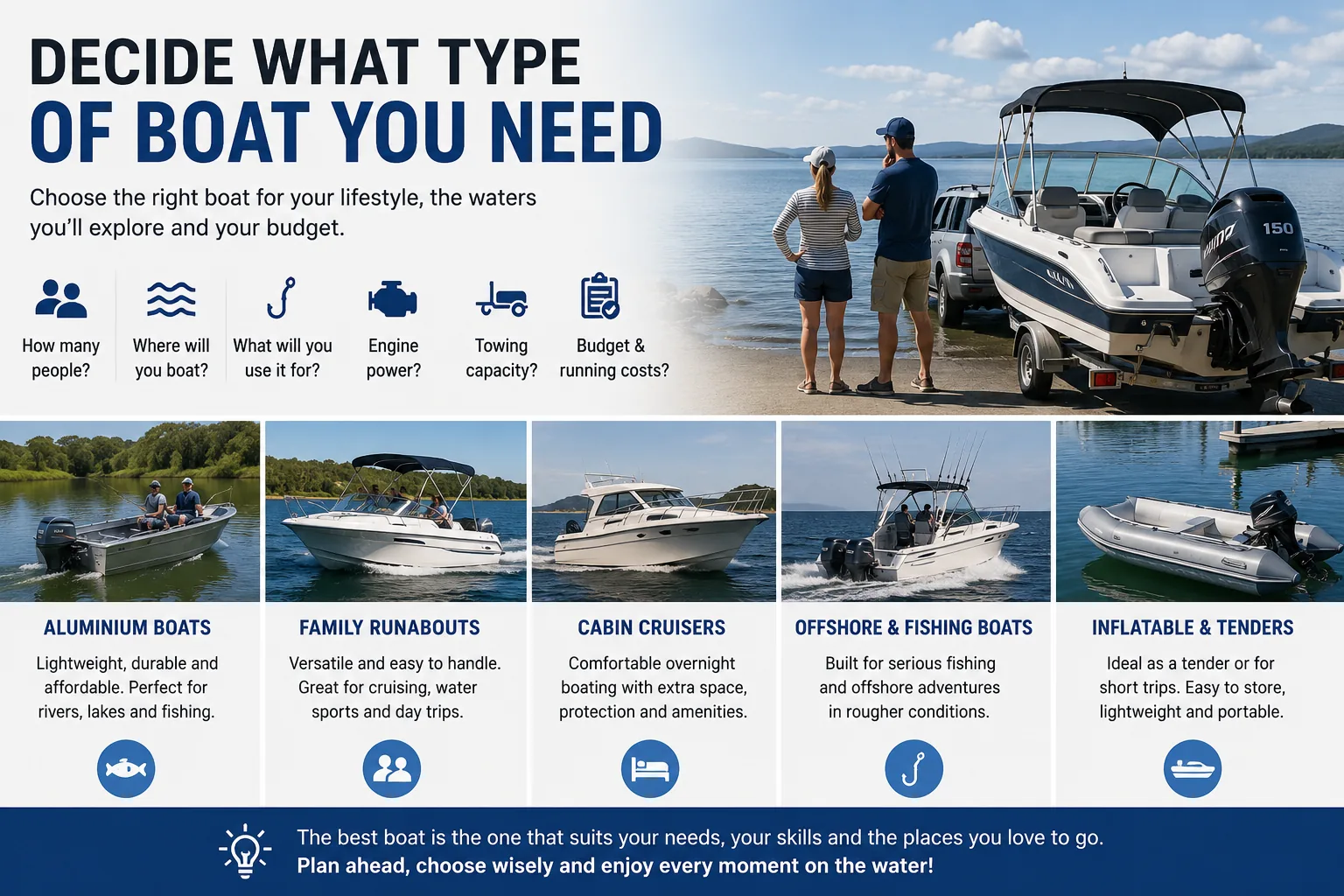
Before browsing advertisements, think carefully about how and where you intend to use the boat.
Different boats are designed for different purposes. A small aluminium dinghy may be ideal for sheltered rivers and estuaries but unsuitable for offshore fishing. A large cabin cruiser may provide comfort and protection but require more maintenance, fuel, storage space and towing capacity.
Consider:
The number of people you expect to carry
Whether you will use the boat on rivers, lakes, bays or offshore waters
Fishing, cruising, diving or water-sports requirements
The size and power of the engine
Your vehicle’s legal towing capacity
Where the boat will be stored
Launching and retrieval requirements
Fuel consumption
Insurance and registration costs
Ongoing servicing and maintenance
The safety equipment required in your state or territory
A larger or more powerful boat is not necessarily the best choice. Select a vessel that suits your experience, budget and intended operating area.
Once you find a suitable advertisement, research the make, model, engine and typical selling price.
Look for:
Reviews from existing owners
Common mechanical or structural problems
Manufacturer recalls or service notices
Replacement-parts availability
Typical fuel consumption
Recommended engine size
Maximum passenger and load capacity
Comparable boats advertised elsewhere
The cost of insurance and storage
Comparing several similar advertisements can help you determine whether the asking price is realistic.
An unusually cheap boat may be a genuine project or urgent sale, but it could also have hidden damage, outstanding finance or be part of a classified advertising scam.
Contact the seller before travelling to inspect the boat. Their answers may help you decide whether the vessel is worth viewing.
Ask:
How long have you owned the boat?
Why are you selling it?
How often has it been used?
Has it mainly been used in salt water or fresh water?
Where has it been stored?
Has the boat ever sunk, flooded or taken on significant water?
Has the hull ever been repaired?
Has it been involved in an accident?
Has the engine ever overheated?
When was the engine last serviced?
Are service records and receipts available?
Are the boat and trailer currently registered?
Is there any finance owing?
Does the seller have proof of ownership?
Is the trailer included in the advertised price?
What safety equipment and accessories are included?
Can the boat be inspected and taken on a sea trial?
Be cautious when the seller refuses an inspection, will not provide identifying numbers or pressures you to send a deposit immediately.
Ask the seller to show identification and evidence that they are entitled to sell the vessel.
Compare the seller’s name with:
The boat registration certificate
Trailer registration documents
Purchase receipts
Service invoices
Insurance records
Finance payout documents, where relevant
The name on every document may not always be identical, particularly when a boat is owned by a company, family member or deceased estate. However, any difference should have a clear explanation supported by appropriate paperwork.
Do not rely entirely on possession of the boat as proof of ownership.
Obtain a written receipt containing:
The buyer’s full name and address
The seller’s full name and address
The purchase date
The agreed price
Boat make, model and registration number
Hull Identification Number
Engine make, model and serial number
Trailer make, registration and VIN or chassis number
A list of included equipment
The signatures of both parties
Keep copies of the advertisement, messages, inspection notes, PPSR certificates and payment records.
The Hull Identification Number, commonly called the HIN, is a unique series of letters and numbers assigned to a vessel. It is usually moulded into the hull or displayed on a permanently attached plate.
The HIN can identify details such as the manufacturer, serial number and date of manufacture. It is also used when conducting a PPSR watercraft search.
Locate the physical HIN and compare it with:
The registration certificate
The seller’s records
The number used for the PPSR search
Any boat-code or inspection documents
Look closely for signs that the HIN has been:
Removed
Altered
Restamped
Covered
Damaged
Replaced with a different plate
A missing or inconsistent HIN requires further investigation before proceeding.
Many recreational powerboats have an Australian Builders Plate, commonly known as an ABP.
The plate can provide important information about:
Maximum engine power
Maximum engine weight
Maximum number of people
Maximum loading capacity
The boat’s buoyancy performance
The information helps buyers understand the vessel’s designed operating limits.
Check that the plate appears genuine and matches the vessel. Consider whether the fitted motor falls within the permitted power and weight limits.
An oversized or excessively heavy engine may adversely affect handling, stability and insurance eligibility.
Some older and exempt vessels may not have an Australian Builders Plate. In that situation, seek reliable information about the boat’s safe capacity and specifications before purchase.
A boat may have money owing even when the seller possesses it and its registration appears current.
The Personal Property Securities Register is Australia’s national register of security interests in personal property. A PPSR search can reveal whether a security interest has been registered against a boat.
When a boat has outstanding finance and the borrower stops making repayments, the lender may be able to repossess it, even after it has been sold to someone else.
The official online self-service PPSR boat search currently costs $2 and requires the boat’s HIN or official number. The PPSR recommends searching immediately before completing the purchase, as close as possible to the time payment is made.
Save the search certificate as a legal record of the result.
A boat and its trailer are separate items for PPSR purposes.
Complete:
A watercraft search using the boat’s HIN or official number.
A motor-vehicle search using the trailer’s VIN or chassis number.
The trailer search may provide information about registered security interests and whether the trailer has been reported stolen or written off.
A boat PPSR search does not necessarily reveal whether the vessel itself has been stolen or badly damaged. Buyers should make additional enquiries with the relevant state or territory maritime authority or police.
The PPSR advises that a watercraft search will not show a security interest registered separately against an outboard motor.
Record the motor’s:
Manufacturer
Model
Horsepower
Serial number
Year of manufacture
Confirm that these details match service records and the seller’s description. When the motor has substantial standalone value, consider obtaining further advice about the most appropriate ownership and finance checks.
Inspect the boat during daylight and allow plenty of time.
Avoid inspecting a wet boat immediately after it has been removed from the water, as water can temporarily conceal leaks, cracks or repairs.
Look for:
Cracks in the gelcoat
Blistering or bubbling
Soft or flexible areas
Discolouration
Impact damage
Poorly matched paint
Uneven surfaces
Exposed fibreglass
Repairs around the keel
Damage around fittings and through-hull openings
Small cosmetic gelcoat cracks may not be serious, but extensive cracking or movement can indicate structural stress.
Pay particular attention to the transom, which supports the outboard motor. Press firmly around mounting bolts and look for flexing, cracking, water stains or previous repairs.
A soft or rotten transom can be expensive to repair.
Check for:
Corrosion
Pitting
Cracks around welds
Bent panels
Loose or leaking rivets
Electrolysis damage
Repairs that do not match the original construction
Damage around the transom and keel
White powdery deposits
Isolated areas of fresh paint
Look underneath the boat, not just along its sides. Grounding damage is commonly found on the keel, chines and lower hull.
Timber boats can provide excellent service but may require specialised maintenance.
Check for:
Rot
Soft timber
Cracked or separated planks
Failed seams
Water staining
Marine growth
Fastener corrosion
Movement around structural joints
Poorly completed repairs
A professional marine survey is particularly valuable when buying an older timber vessel.
Walk carefully around the deck and internal floor.
Look and feel for:
Soft areas
Flexing
Cracks
Loose fittings
Water trapped below the floor
Signs of mould or persistent damp
Rust stains
Damaged hatches
Loose seats
Failed sealant
Corrosion around screws and fittings
A soft floor may indicate water-damaged timber beneath the fibreglass.
Check the transom from inside and outside. Look for movement when pressure is applied to the motor, cracks extending from mounting points and moisture around bolts or fittings.
The bilge is the lowest internal area of the boat, where water and other fluids may collect.
A small amount of clean water may not be unusual, but investigate:
Excessive standing water
Oil or fuel
Strong petrol smells
Corrosion
Damaged wiring
Blocked drainage
Loose hoses
Failed pumps
Unsealed holes
Signs that water has remained for long periods
Test the bilge pump and its automatic float switch where fitted.
Check the drain plug, housing and surrounding material. A damaged or poorly sealed drain fitting can allow water into the hull or structural materials.
The engine is often one of the most valuable components of a used boat. Major repairs or replacement can quickly turn an apparently inexpensive purchase into a costly project.
A qualified marine mechanic should inspect the engine when its condition is uncertain or the purchase value is significant.
Before starting the motor, check:
Oil levels and condition
Fuel lines
Electrical cables
Battery terminals
Cooling hoses
Engine mounts
Propeller
Skeg
Gearbox housing
Corrosion
Fluid leaks
Damaged wiring
Missing or loose bolts
Salt deposits
Heavy corrosion beneath a recently cleaned or painted cover may indicate an attempt to conceal deterioration.
Ask the seller not to start the engine before you arrive.
A warm engine can hide:
Difficult cold starting
Battery weakness
Excessive smoke
Fuel-system problems
Unusual noises
Poor compression
Confirm that the engine is genuinely cold before it is started.
Listen for knocking, rattling, grinding or irregular idling. Watch for warning lights, alarms, smoke and abnormal vibration.
Most marine engines rely on water for cooling.
Check that cooling water flows correctly after startup. Weak or inconsistent flow may indicate a blocked intake, failed impeller or cooling-system problem.
Never run an engine out of water unless it is connected to an appropriate flushing device and the manufacturer’s procedures are followed.
Engine hours can be useful, but they do not tell the complete story.
A low-hour engine may have deteriorated through:
Long periods without use
Inadequate flushing
Poor storage
Old fuel
Internal corrosion
Missed servicing
A well-maintained higher-hour engine may be a better purchase than a neglected low-hour motor.
Ask for invoices showing:
Regular servicing
Water-pump or impeller replacement
Gearbox-oil changes
Spark-plug replacement
Fuel-system servicing
Timing-belt replacement where applicable
Anode replacement
Major repairs
Confirm that the serial number on the invoices matches the motor.
Depending on the engine and purchase price, a marine mechanic may recommend:
Compression testing
Computer diagnostic scanning
Gearbox-oil inspection
Cooling-system checks
Charging-system tests
Fuel-pressure testing
Cylinder leak-down testing
Inspection for stored fault codes
Diagnostic data may reveal engine hours, operating ranges, overheating events or fault history on compatible engines.
Fuel leaks on a boat create a serious fire and safety risk.
Check:
Fuel tanks
Filler hoses
Vent lines
Primer bulbs
Fuel filters
Connections
Shut-off valves
Tank straps
Corrosion around metal tanks
Cracked or hardened hoses
Smell for petrol fumes, particularly in enclosed spaces.
Older fuel can cause starting and performance problems. Ask when the boat was last used and whether fuel stabiliser has been used during storage.
Turn the steering fully from side to side.
It should move smoothly without excessive stiffness, grinding or free play.
Inspect:
Steering cables
Hydraulic hoses
Helm components
Connections at the engine
Throttle controls
Gear-selection controls
Trim and tilt operation
A stiff steering cable can fail and may require replacement.
Check that the throttle moves smoothly and the engine shifts correctly between neutral, forward and reverse during an appropriate on-water test.
A damaged propeller can reduce performance, cause vibration and place additional strain on the gearbox.
Check for:
Bent blades
Cracks
Missing sections
Significant edge damage
Fishing line around the shaft
Oil leaking from the lower unit
Damage to the skeg
Excessive movement in the propeller shaft
Fishing line wrapped around the shaft can damage seals and allow water into the gearbox.
Milky or contaminated gearbox oil may indicate water intrusion, although this should be assessed by a qualified mechanic.
Marine electrical problems can be difficult to trace and expensive to repair, particularly when wiring has been repeatedly modified.
Inspect wiring for:
Corrosion
Loose connections
Household wiring products
Twisted and taped joints
Unprotected terminals
Missing fuses
Melted insulation
Unsupported cables
Water exposure
Test all fitted equipment, including:
Navigation lights
Anchor light
Bilge pump
Horn
Cabin lights
Instruments
Engine trim
Radios
Fish finder
GPS or chartplotter
Pumps
Wipers
Power outlets
Check the battery’s age, physical condition and mounting system. Batteries should be securely restrained and their terminals protected against accidental contact.
Safety-equipment rules for recreational boats vary between states and territories and may depend on the boat, operating area and distance from shore.
Do not assume that equipment included with the sale satisfies current requirements.
Inspect:
Lifejackets
Flares
Emergency Position Indicating Radio Beacon
Fire extinguisher
Anchor and line
Marine radio
Bailer or bilge pump
First-aid kit
Navigation lights
Signalling equipment
Torch
Paddles or oars, where appropriate
Check expiry dates, condition, approvals and suitability.
AMSA directs recreational boaters to their state or territory maritime authority for the lifejacket and safety-equipment rules that apply to them.
Treat old or questionable safety equipment as needing replacement when calculating the total purchase cost.
A boat trailer is exposed to water, road debris and heavy loads. Saltwater trailers can corrode internally even when the exterior looks reasonable.
Inspect:
Chassis and cross-members
Welds
Drawbar
Springs
Axles
Wheel bearings
Tyres
Brakes
Coupling
Safety chains
Winch
Winch strap or cable
Rollers and skids
Lights and wiring
Mudguards
Jockey wheel
Tie-down points
Look underneath and inside accessible chassis sections.
Tap suspicious metal gently and look for swelling, flaking, cracking or perforation. Fresh paint may improve appearance but can also conceal corrosion.
Inspect each tyre for:
Cracks
Uneven wear
Sidewall damage
Low tread
Incorrect load rating
Old manufacturing dates
Underinflation
Boat trailers may travel relatively few kilometres, so tyres can deteriorate with age before their tread wears out.
Do not forget the spare wheel.
Raise each wheel safely and rotate it if the seller permits.
Listen for grinding and feel for roughness or excessive movement.
Ask:
When were the bearings last serviced?
Were they inspected after saltwater use?
Are bearing protectors fitted?
Are replacement bearings carried with the trailer?
A failed wheel bearing can leave the boat and trailer stranded or cause loss of a wheel.
Compare the physical VIN or chassis number with the trailer registration papers.
Remember to perform a separate PPSR vehicle search on the trailer immediately before purchase. The boat’s watercraft search does not cover the trailer.
Confirm that your towing vehicle can legally tow the combined weight of the boat, motor, fuel, trailer, batteries and equipment.
A visual inspection cannot reveal how the boat performs on the water.
Whenever practical, arrange a sea trial with the seller.
During the trial, check:
Cold starting
Idle quality
Acceleration
Steering
Gear selection
Trim operation
Engine temperature
Warning alarms
Maximum engine speed
Vibration
Water leaks
Bilge-pump operation
Instruments
Electronics
Stability
Handling
Whether the boat lists to one side
Test the boat under realistic load where possible.
After returning to the ramp, inspect the bilge for new water and check the engine for leaks, unusual smells or excessive heat.
The seller should operate the boat unless you hold the required licence and have permission to take control.
A marine survey is an independent inspection of the boat’s condition and construction.
A survey is particularly worthwhile when buying:
A high-value boat
An older vessel
A yacht
A timber boat
A boat with previous repairs
A vessel with an inboard engine
A boat intended for offshore use
A vessel located interstate
A boat with unclear maintenance history
The surveyor may examine the hull, deck, structure, fittings, systems and visible evidence of damage or deterioration.
A survey does not necessarily replace a separate engine inspection. Consider engaging both a marine surveyor and a qualified marine mechanic.
Ask your insurer whether a survey will be required before cover is provided.
Recreational boat registration is administered by state and territory authorities, and requirements differ across Australia.
Before buying, confirm:
Whether the vessel must be registered
Whether the registration is current
Whether the registration number matches the vessel
Which transfer documents are required
The transfer deadline
Applicable fees or duties
Requirements for interstate boats
Whether the trailer requires a separate transfer
Whether a licence is needed to operate the vessel
For example, buyers generally need to complete a vessel registration transfer within 14 days in New South Wales, Queensland, Victoria and South Australia.
Victoria handles the boat and trailer as separate registration transfers, even though the documents may be lodged together.
Western Australia allows eligible vessel transfers through DoTDirect and applies its own registration and interstate-use requirements.
Check the current requirements directly with your state or territory authority before completing the purchase.
An interstate boat may provide more choice, but it also introduces additional costs and risks.
Consider:
Travel expenses
Independent inspections
Transport or delivery charges
Interstate registration requirements
Trailer permits
Insurance during transport
Difficulty resolving disputes
Different safety-equipment requirements
The cost of returning the boat if it is misrepresented
Do not send full payment solely on the basis of photographs and messages.
Arrange an independent survey and mechanical inspection when you cannot inspect the boat personally.
Verify the transport company independently rather than relying on contact details supplied by the seller.
The advertised price is only one part of the cost of owning a boat.
Allow for:
Registration transfer
Trailer transfer
Stamp duty where applicable
Insurance
Marine survey
Mechanical inspection
Immediate servicing
Replacement batteries
New tyres
Wheel-bearing service
Safety equipment
Mooring or storage
Fuel
Launching fees
Towing equipment
Repairs and upgrades
A cheaper boat needing extensive work may cost more than a better-maintained example with a higher asking price.
Prepare a realistic first-year budget before committing.
Do not proceed when the seller:
Refuses an inspection
Will not permit a sea trial without a reasonable explanation
Cannot demonstrate ownership
Will not provide the HIN or trailer VIN
Provides numbers that do not match the documents
Pressures you to pay immediately
Requests payment through an unusual method
Refuses a professional inspection
Conceals known damage
Provides inconsistent answers
Claims the boat is elsewhere with a courier
Offers an expensive boat at an implausibly low price
Cannot explain major repairs
Wants payment sent to an unrelated person
Finding another boat is generally easier than resolving ownership, finance or structural problems after purchase.
Use this summary when viewing a boat.
Seller’s identity checked
Proof of ownership sighted
Boat registration checked
Trailer registration checked
HIN matches all documents
Engine serial number recorded
Trailer VIN or chassis number matches
Service history reviewed
Repair invoices reviewed
Written receipt prepared
PPSR watercraft search completed
PPSR trailer search completed
Searches conducted immediately before payment
Search certificates saved
Finance issues resolved in writing
State or territory vessel-status checks completed
Hull inspected underneath
No serious cracks or corrosion
Transom feels solid
Floor and deck feel firm
Bilge checked
Drain plug and fittings inspected
Previous repairs assessed
HIN has not been altered
Australian Builders Plate checked
Engine started from cold
Cooling-water flow checked
No unusual smoke or noise
Service records confirmed
Steering moves smoothly
Throttle and gears tested
Trim and tilt tested
Propeller and lower unit inspected
Qualified mechanical inspection considered
Battery checked
Wiring inspected
Navigation lights tested
Bilge pump tested
Instruments tested
Electronics tested
Fuel tank and hoses checked
No fuel leaks or strong fumes
Chassis checked for corrosion
Tyres inspected
Bearings checked
Brakes inspected
Coupling and chains checked
Winch and strap checked
Lights tested
Spare wheel inspected
Tow vehicle capacity confirmed
Sea trial completed
Boat accelerates correctly
Steering and handling assessed
No excessive vibration
Engine temperature remains normal
No warning alarms
No unexpected water in bilge
All major systems operate correctly
Yes. A PPSR watercraft search can identify a registered security interest against the boat, which may indicate that money is still owing.
Conduct the search as close as possible to the time of purchase and retain the certificate.
No. The boat and trailer should be searched separately.
Search the boat using its HIN or official number and the trailer using its VIN or chassis number.
A watercraft PPSR search primarily identifies registered security interests. Official PPSR guidance says buyers need to contact their state or territory maritime authority or police to investigate whether a boat or jet ski has been stolen or badly damaged.
A survey is not required for every purchase, but it can be valuable for older, expensive, repaired, timber or offshore vessels.
Insurance providers may also require a survey for certain boats.
A purchase without a sea trial carries additional risk because you cannot properly assess handling, engine performance, steering, vibration or water entry.
When a sea trial is impossible, obtain professional inspections and negotiate on the basis of the increased uncertainty.
Obtain a signed receipt, registration-transfer documents, service history, evidence of ownership and details of the boat, engine and trailer.
Requirements vary by state and territory, so confirm the correct process with the relevant authority.
Do not make payment until the finance is properly discharged.
When finance exists, contact the lender using independently verified details and arrange a documented payout process. Do not rely solely on the seller’s promise that the debt will be paid later.
Buying a used boat can provide excellent value, but it should never be rushed.
Inspect the hull, engine, systems and trailer carefully. Verify the seller’s ownership, match every identification number and complete separate PPSR searches for the boat and trailer immediately before paying.
For higher-value vessels, an independent marine survey and mechanical inspection can identify problems that may otherwise remain hidden until after the purchase.
Taking these precautions can help you choose a safer, more suitable boat and avoid unexpected repair bills, registration difficulties or finance disputes.
Looking for your next boat? Browse used boats, marine equipment and boat trailers advertised across Australia on AU Classifieds. Sellers can also place a free classified advertisement and connect with buyers in their local area.
AU Classifieds connects buyers and sellers throughout Australia. Users should independently inspect products, verify ownership and conduct all appropriate searches before entering into a transaction.




 Welcome!